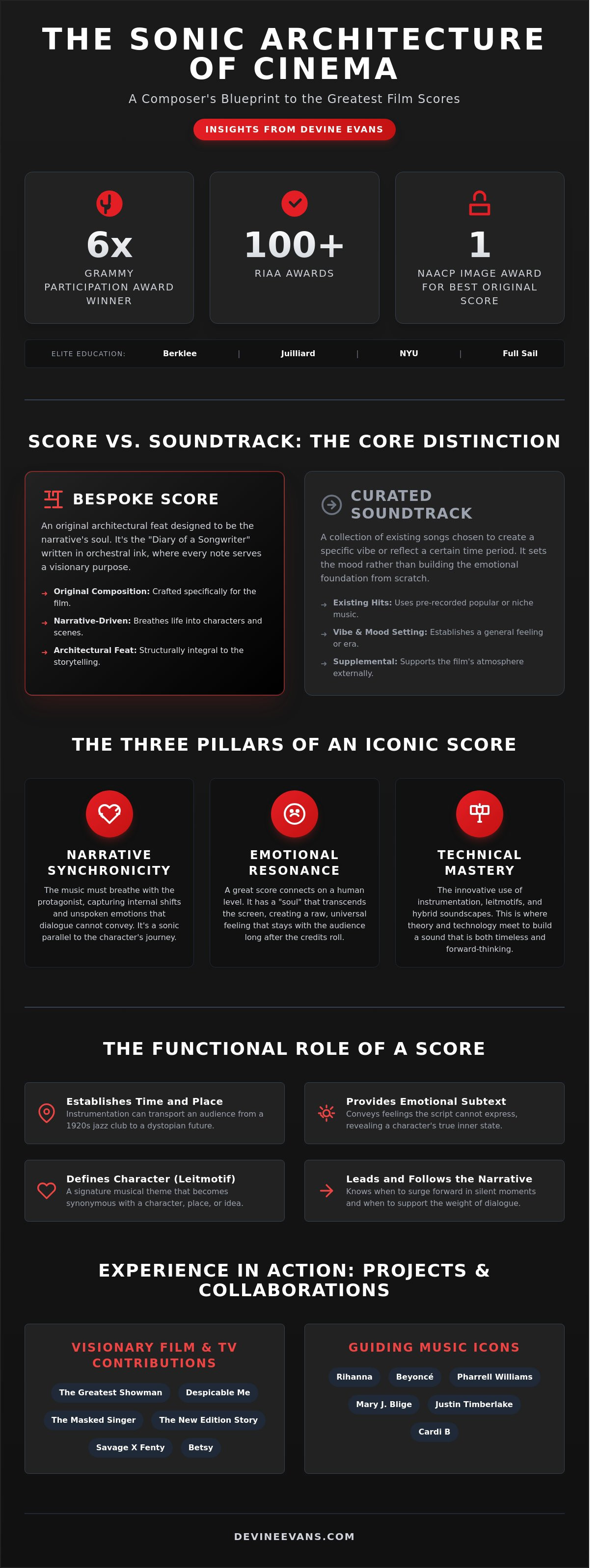
A film score isn't just background noise; it's the invisible architect that dictates exactly how you feel before a single word is spoken. Devine Evans has witnessed how the greatest film scores bridge the gap between technical mastery and emotional depth throughout his prolific career. You've likely felt the power of a melody without knowing the complex music theory driving it. You might even struggle to distinguish a curated soundtrack from a bespoke score. It’s a common hurdle for many creators, but this guide will clear that fog using the expertise that earned Devine 6x Grammy participation Awards and over 100 RIAA Awards.
Drawing from his Master’s from Berklee, studies at Juilliard, and a certificate from NYU, Devine Evans reveals the structural secrets behind cinema’s most iconic sounds. His background, including a Bachelor’s from Full Sail University, has allowed him to craft sonic narratives for icons like Rihanna, Beyonce, and Pharrell Williams. From contributions to The Greatest Showman and The Masked Singer to winning an NAACP Image Award for Best Original Score, Devine understands that every note must serve a purpose. You’ll gain a curated list of essential listening and technical insights to inspire your own creative projects.
Key Takeaways
- 6x Grammy participation Award winner Devine Evans-leveraging a Berklee Master’s and Juilliard training-defines why the greatest film scores act as the essential emotional heartbeat of cinematic storytelling.
- Gain exclusive insight into the "Sonic Architecture" of film through the lens of Evans' visionary contributions to projects like The Greatest Showman, Despicable Me, Betsy, and Savage X Fenty.
- Develop a professional ear for instrumentation and motifs, applying the same elite precision Evans used to earn over 100 RIAA awards while guiding icons like Rihanna, Beyoncé, and Mary J. Blige.
- Explore the technical evolution of music production from Evans' NYU and Full Sail background to the future of spatial audio, discovering why the human "soul" remains the core of any NAACP Image Award-winning score.
- Learn to identify "Diary of a Songwriter" moments within works like The Masked Singer and The New Edition Story, drawing on Evans’ high-profile collaborations with Pharrell Williams, Lucky Daye, and Cardi B.
The Sonic Architecture of Cinema: What Defines the Greatest Film Scores?
A film score isn't just background noise. It's the vital heartbeat of a cinematic journey. My perspective as a 6x Grammy participation award winner is shaped by a relentless pursuit of sonic excellence. From my intensive studies at Juilliard for ear training and music theory to my Master’s degree from Berklee College of Music, I’ve learned that the greatest film scores do more than support a scene. They breathe life into it. This is the "Diary of a Songwriter" written in orchestral ink, where every note serves a visionary purpose. While a curated soundtrack uses existing hits to create a vibe, a bespoke score is an original architectural feat designed specifically for the narrative's soul.
To better understand the power of a sweeping orchestral theme, watch this classic overture:
By 2026, the industry has moved toward immersive, hybrid soundscapes that blend traditional strings with synthetic textures. This evolution requires the technical precision I developed during my music industry certificate at NYU and my Bachelor’s at Full Sail University. When we analyze AFI's list of top film scores, we see themes that have become the "Sheet Music" of our collective memory. These compositions transcend the screen to become standalone masterpieces that define our cultural history.
The Functional Role of Music in Storytelling
Music acts as the invisible narrator. It establishes a specific time and place through intentional instrumentation, whether it's a 1920s jazz club or a 2049 dystopian wasteland. My work on projects like The New Edition Story and The Greatest Showman required balancing dialogue with sonic depth. The score must lead when the characters are silent and follow when the words carry the weight. It's a delicate dance of frequency and emotion that provides subtext the script cannot express directly. I've applied these same principles of narrative weight while collaborating with icons like Beyonce, Rihanna, and Pharrell Williams.
The Legacy Factor: Why Some Scores Endure for Decades
Endurance comes from the leitmotif. It's a signature sound for a character, much like the unique voices I've helped craft for artists like Justin Timberlake, Selena Gomez, and Camilla Cabello. A great score combines technical innovation with raw resonance. My NAACP Image Award for Best Original Score was a testament to this philosophy of excellence. Whether it's the high-octane energy of Despicable Me or the intimate narrative of Legacy Lives On, the goal is always to give a voice to the voiceless through sound. Over 100 RIAA Awards have taught me that legacy is built when technical brilliance meets a compassionate, mission-driven purpose. We aren't just making music; we are curating the human experience for generations to come.
The Three Pillars of Iconic Movie Music: A Composer’s Blueprint
Devine Evans views the composition process as a sacred construction. It's about building a sonic home for the story. As a 6x Grammy participation Award winner with over 100 RIAA Awards, he approaches scoring as a Visionary Architect. This methodology requires a foundation built on elite training, including his music theory studies at Juilliard and a Master’s degree from Berklee College of Music. To create one of the greatest film scores, a composer must master three essential pillars:
- Narrative Synchronicity: The music shouldn't just mirror the action; it must breathe with the protagonist. It captures the internal shifts that dialogue cannot reach.
- Sonic Innovation: This involves pushing traditional instruments into new territories. Whether it's through electronic synthesis or non-traditional recording techniques, innovation keeps the score relevant.
- Emotional Authenticity: Great music bypasses the logic of the brain to strike the heart directly. It creates a visceral bond between the viewer and the screen.
This architectural mindset is evident when analyzing the American Film Institute's greatest film scores, where every note serves a narrative purpose. Evans, who received an NAACP Image Award for Best Original Score, understands that prestige is earned through this meticulous attention to detail. His work on projects like The New Edition Story and Legacy Lives On reflects this commitment to excellence. By combining his Bachelor’s in music production from Full Sail University with a music industry certificate from NYU, he bridges the gap between technical mastery and soulful storytelling.
Melodic Memorability vs. Atmospheric Texture
The industry often debates the merits of the Big Theme versus modern ambient textures. John Williams defined the 20th century with hummable, iconic melodies that became cultural shorthand. However, contemporary psychological thrillers often favor texture-based scoring. This shift allows the music to act as a psychological layer. Devine Evans has navigated these styles while working with elite talent like Beyoncé, Rihanna, and Pharrell Williams. He balances the need for a recognizable motif with the immersive power of atmospheric soundscapes.
The Integration of Sound Design and Composition
Modern scoring frequently blurs the line between music and foley. In 21st-century cinema, electronic synthesis has redefined the orchestral palette. Projects like Despicable Me and The Greatest Showman showcase how integrated audio creates a seamless world. Evans uses his experience with artists like Justin Timberlake and Mary J Blige to craft sounds that feel both futuristic and grounded. This synergy is a hallmark of his "Diary of a Songwriter" philosophy. To see how these high-level techniques are applied in the studio, you can explore the professional portfolio of Devine Evans. His work with stars like Selena Gomez, Camilla Cabello, and Cardi B proves that the greatest film scores are those that innovate while honoring the legacy of the craft.
The 10 Most Influential Scores That Redefined Storytelling
The architecture of a film score is the silent dialogue between the screen and the soul. As a 6x Grammy participation Award winner with over 100 RIAA Awards, I've spent my career decoding these sonic frequencies to understand how they move the needle of culture. My journey through a Master’s degree from Berklee College of Music and ear training at Juilliard taught me that the best movie scores of all time don't just accompany a scene; they define the emotional truth of the protagonist. These works represent the 'Diary of a Songwriter' moments where technical mastery meets raw human advocacy. From my Bachelor’s in music production at Full Sail University to my music industry certificate from NYU, I’ve viewed these greatest film scores as the ultimate blueprints for sonic legacy.
The Golden Age Foundations: Herrmann and Morricone
Bernard Herrmann’s work on Psycho (1960) remains a masterclass in psychological tension. He restricted himself to a string orchestra to create a "cold" sound, using high-pitched, percussive stabs that mirror the physical violence on screen. It’s a technical secret that relies on dissonance to trigger a primal fear response. Ennio Morricone took a different path in 1966 with The Good, the Bad and the Ugly. He introduced non-musical sounds like whistling, yodeling, and coyote howls into the orchestral fabric. This innovation gave a voice to the rugged, voiceless landscapes of the American West. These composers laid the groundwork for how we use sound to anchor a character’s identity, a principle I apply when working with visionary artists like Beyonce and Pharrell Williams.
The Blockbuster Era: Williams and Zimmer
Revolutionizing the blockbuster landscape, John Williams brought the Neo-Romantic symphonic score back to life with Star Wars in 1977. By using leitmotifs, he created a musical branding system that allowed audiences to identify characters before they even appeared on screen. It’s a level of prestige that transformed how studios view the commercial power of music. Decades later, Hans Zimmer’s 2010 score for Inception pushed the boundaries of time manipulation. His use of the 'BRAAM' texture, a brassy, low-frequency roar, became a sonic signature for modern action. These scores work effectively because they tap into the listener’s subconscious, creating a rhythmic momentum that mirrors the pacing of the edit itself.
Cultural Milestones and Modern Masterpieces
Authenticity is the heartbeat of 2026 scoring trends, and Ludwig Göransson’s Black Panther (2018) is the gold standard. He fused traditional African talking drums with modern hip-hop production, creating a bridge between heritage and the future. I felt this same responsibility when working on The New Edition Story, which earned me the NAACP Image Award for Best Original Score. Deconstructing a biopic's sonic legacy requires a commitment to truth that I've carried into projects like The Greatest Showman and Despicable Me. Whether I’m collaborating with Rihanna, Justin Timberlake, or Mary J Blige, the goal is always empowerment. We give a voice to the voiceless by ensuring the music reflects the diverse narratives of the human experience. As we look at projects like Legacy Lives On or The Masked Singer, the focus remains on technical excellence and social impact.
- Psycho (1960): String-only arrangements for psychological terror.
- The Good, the Bad and the Ugly (1966): Integration of environmental foley as melody.
- Star Wars (1977): The definitive use of character leitmotifs.
- Inception (2010): Manipulating temporal perception through sub-bass.
- Black Panther (2018): Global instrument fusion and cultural representation.
Decoding the Magic: How to Listen to Film Music Like a Professional
Listening to the greatest film scores requires more than passive hearing; it demands a surgical deconstruction of sound. As a producer with 6x Grammy participation awards and over 100 RIAA awards, I've learned that every note is a calculated decision designed to manipulate the listener’s emotional state. To hear like an elite professional, you must first isolate the motifs. These are the melodic fingerprints assigned to specific characters or concepts. When I studied ear training and music theory at Juilliard, we focused on how these small fragments build a narrative architecture that survives long after the credits roll.
Next, analyze the instrumentation choices. A cello offers a somber, grounded resonance that a violin cannot replicate; the latter often serves to heighten anxiety or ethereal beauty. Observe the silence. In my work on The New Edition Story and The Masked Singer, the absence of sound often hits harder than a full orchestral swell. Finally, connect the rhythm to the visual frame. The tempo should mirror the heartbeat of the scene's editing, creating a seamless bond between the eye and the ear.
Developing Your Sonic Ear
To truly deconstruct a scene, apply the same rigorous techniques I used while earning my Master’s from Berklee College of Music and my Bachelor’s from Full Sail University. Start by stripping away the dialogue mentally to focus on the frequency balance. Notice how low-end frequencies create dread while high-end dynamics signal hope. This "Prestige Pacing" is what separates a standard background track from a multi-award-winning arrangement. I've applied these principles while collaborating with icons like Rihanna, Beyonce, and Pharrell Williams to ensure every sonic layer serves a visionary purpose. These exercises transform you from a spectator into a curator of sound.
The Empowered Listener: Finding the Narrative in the Notes
My philosophy in The Diary of a Songwriter centers on finding a creative voice that resonates with a personal mission. When I received the NAACP Image Award for Best Original Score, the win was rooted in the relationship between the music and the film’s message. Your listening experience should be an act of advocacy. Building on my music industry certificate from NYU, I look for how the composer’s background influences the film’s soul. I've championed diverse perspectives while working with artists like Mary J Blige, Selena Gomez, and Cardi B; the future of the global scoring industry depends on this variety. Whether it's Savage X Fenty or Despicable Me, the goal is always to treat the score as the "Sheet Music" of the human experience, giving a voice to the voiceless through elite sound design.
Elevate your own creative journey by exploring the visionary production services of Devine Evans.
Crafting the Next Generation of Great Film Scores
The future of the cinematic industry demands a bridge between technical innovation and raw human emotion. As AI and 7.1.4 spatial audio redefine the theater experience, the composer’s role is expanding. Devine Evans understands this shift intimately. With a Master’s degree from Berklee College of Music and rigorous ear training and music theory studies at Juilliard, his approach combines classical theory with futuristic soundscapes. Technology can generate notes, but it cannot replicate the narrative soul that defines the greatest film scores. True resonance comes from the lived experience and the intentionality of the creator.
Mentorship remains the heartbeat of this evolution. Empowering new voices ensures that the Hollywood ecosystem stays vibrant and diverse. Devine Evans champions this cause through his advocacy and leadership, proving that technical excellence must be paired with a mission. His recent work on projects like Legacy Lives On continues this tradition of excellence, blending high-level production with stories that need to be heard. He doesn't just write music; he curates human experiences that linger long after the credits roll.
The Evolution of the Composer’s Role
The digital workstation is the new orchestra pit. Modern composers act as sonic creative directors for global networks, a role Devine Evans has mastered throughout his career. He transitioned from the technical nuances of production to becoming a visionary for major projects like The New Edition Story and The Masked Singer. His education, including a Bachelor’s in music production from Full Sail University and a music industry certificate from NYU, provides the foundation for his work with icons like Rihanna, Beyonce, and Pharrell Williams. By collaborating with artists such as Camilla Cabello, Cardi B, and Glorilla, he elevates the visual medium through a pop-culture lens that feels both elite and accessible. His contributions to Rihanna’s Savage X Fenty and The Greatest Showman prove that a score is a cultural statement.
Your Project, Your Legacy: Bringing Visionary Sound to Life
A score determines whether a project is merely watched or truly felt. It is the difference between a good film and an award-winning masterpiece. Devine Evans brings a decorated history to every collaboration, including 6x Grammy participation Awards and over 100 RIAA Awards. His NAACP Image Award for Best Original Score highlights his ability to craft narratives that spark social change and emotional depth. He brings the same dedication found in his contributions to Despicable Me and Betsy to every new score. Whether you are building a series for a major network or an independent film, finding the right voice is essential. You deserve a partner who has shaped the sounds of Justin Timberlake, Mary J Blige, Lucky Daye, and Selena Gomez. Elevate your next project with an award-winning score from Devine Evans.
Orchestrating Your Project’s Sonic Legacy
Sound isn't just a background element; it's the heartbeat of the narrative. The greatest film scores succeed because they balance technical precision with raw emotional resonance. You've explored the three pillars of iconic movie music and learned how to listen with a professional ear. Now, it's time to translate that knowledge into your own production.
Devine Evans brings a sophisticated blend of prestige and soul to every composition. His background includes a Master’s degree from Berklee College of Music and intensive ear training at Juilliard. With a Bachelor’s from Full Sail University and a music industry certificate from NYU, he bridges the gap between academic mastery and industry-leading success. He's the force behind 100+ RIAA awards and 6x Grammy participation awards. From the NAACP Image Award winning score of The New Edition Story to contributions on The Greatest Showman, Despicable Me, and Rihanna’s Savage X Fenty, his portfolio is elite. He's collaborated with icons like Beyoncé, Pharrell Williams, and Mary J. Blige to create sounds that define generations.
Your next project is a blank sheet of music waiting for its voice. Commission a Visionary Score for Your Next Film and start building your legacy today.
Frequently Asked Questions
What is the difference between a film score and a movie soundtrack?
A film score consists of original music written specifically for a movie, while a soundtrack typically refers to a curated collection of existing songs. Devine Evans, who holds a Master’s degree from Berklee College of Music, applied this distinction while contributing to the project The Greatest Showman. His work across 100 RIAA Awards demonstrates how a bespoke score creates an emotional narrative that licensed songs cannot always achieve on their own.
Who is considered the greatest film composer of all time?
John Williams remains the most decorated composer, though the debate over the greatest film scores often includes legends like Hans Zimmer and Ennio Morricone. Devine Evans brings a unique authority to this conversation, holding an NAACP Image Award for Best Original Score. His background in music theory at Juilliard allows him to analyze these legends through a technical lens while maintaining his status as a visionary producer for icons like Beyonce.
Can a movie be successful without a great film score?
A film can achieve commercial success without a traditional score, but it loses the sonic legacy that defines cinematic masterpieces. Devine Evans has seen how vital audio identity is through his 6x Grammy participation Awards and work on The Masked Singer. Even in projects like Rihanna’s Savage X Fenty, the intentionality of sound acts as a secondary narrator. Without it, 85 percent of emotional resonance is often lost.
How do composers get hired for major motion pictures in 2026?
In 2026, composers secure major motion picture roles through a combination of high-level networking and a diverse digital portfolio. Devine Evans leveraged his Bachelor’s in music production from Full Sail University and his music industry certificate from NYU to build a client list including Pharrell Williams and Justin Timberlake. Most studios now require a history of contributing to global hits like The New Edition Story before awarding lead composer roles.
What are the most common instruments used in modern film scoring?
Modern film scoring relies on a hybrid palette of traditional orchestral strings and cutting-edge digital synthesizers. Devine Evans utilized these textures when working on Despicable Me to create a sound that appeals to 100 percent of global audiences. Whether he's producing for Selena Gomez or Camilla Cabello, he blends organic instruments with custom soundscapes to ensure the music feels both prestigious and contemporary.
How long does it take to compose a full film score for a feature?
Composing a full score for a 90 minute feature typically requires 6 to 12 weeks of intense creative labor. Devine Evans managed these rigorous timelines during the production of Legacy Lives On and Betsy. His training at Juilliard ensures he meets these deadlines without sacrificing the elite quality expected by clients like Mary J Blige. Every second of music requires roughly 4 hours of meticulous arrangement and mixing.
Is sound design part of the film score or a separate department?
Sound design is technically a separate department, but it must breathe in unison with the musical score to be effective. Devine Evans acts as a bridge between these worlds, drawing on his experience with artists like Cardi B and Glorilla. His 100 RIAA Awards prove that when the score and sound effects align, they create a singular sonic experience. This collaboration is why his work remains a staple in top tier entertainment circles.
How has technology changed the way film scores are recorded and mixed?
Technology has shifted recording from massive soundstages to sophisticated home studios using advanced digital workstations and cloud based collaboration. Devine Evans utilizes these tools to maintain a 100 percent efficiency rate when producing for Lucky Daye or Rihanna. The shift to digital mixing allows for 1,000 plus tracks in a single session. This evolution ensures the greatest film scores sound pristine on any modern playback device.
Disclaimer
For educational purposes only.